

TRANSPORTATION
A.
Passenger Vehicles
Remote exploitation to control
Uconnect system and GPS
Details here: Remote Exploitation of an Unaltered Passenger Vehicle – IOActive
Remote Exploitation of an Unaltered Passenger Vehicle
The paper “Remote Exploitation of an Unaltered Passenger Vehicle” by IOActive is a landmark automotive cybersecurity study that proved a modern car can be remotely compromised without any physical modification.
What the research demonstrated:
Full remote attack chain:
Researchers accessed the vehicle over a wireless interface (cellular-connected infotainment/telematics).
No aftermarket hardware:
The vehicle was unaltered—exactly as sold to consumers.
Lateral movement inside the car:
From the infotainment system to critical internal networks.
Control over safety-relevant functions:
Including braking, steering, acceleration, and dashboard indicators (in controlled conditions).
This was a wake-up call that cars had effectively become rolling, internet-connected computers.
Why
It Mattered (and Still Does)
At the time, automotive security relied heavily on:
Perimeter trust
(assuming internal vehicle networks were safe)
Limited authentication
between ECUs
Minimal secure coding practices
in non-safety systems
The IOActive research showed that:
A compromise of non-safety software can cascade into safety-critical impact.
Key Security Lessons for Transportation Software
Attack Surface Expansion
- Telematics, infotainment, V2X, OTA updates = remote entry points
- Supply-chain software became part of the threat model
Lack of Segmentation
Weak isolation between infotainment and CAN networks
Insufficient message authentication on in-vehicle buses
Software Quality = Safety
- Memory corruption, insecure APIs, and logic flaws enabled escalation
- Traditional safety standards alone were not enough
Long-term Industry Impact
This research directly influenced:
Adoption of secure gateways and ECU isolation
Introduction of UNECE R155 / ISO 21434
Increased focus on secure coding and static analysis
OEM bug bounty programs and red-team testing
Why this case is still relevant for AI Cyber Reasoning Engine
Remote exploitation chains typically start with:
- Unsafe memory usage (C/C++)
- Input validation failures
- Logic flaws in complex, legacy codebases

addresses exactly these issues:
Detects exploit primitives before vehicles ship
Prioritizes findings by safety and real-world impact
Supports compliance evidence for automotive cybersecurity regulations
B.
“The great train robbery”
3ncrypt10n
- ERTMS Euroradio Safety Layer
- RBC-RBC Safe Communication Interface
- VPN over GSM
Sicherheit von ETCS (2) Schlüsseltausch

Option 1: Fahrzeug besitzt einen Schüssel, in allen Domänen gültig
Option 2: Pro Domäne ein Schüssel
28C3: Stefan Katzenbeisser: Can trains be hacked?
Today:
Locomotive
- Traction motors control / Cab
- Signaling Automatic Train Control
- Passenger Information and Entertainment
Wayside / Stations
- Computer base interlocking / Centralized traffic control
- Marshalling yard automation
- Automated railway level crossing protection system
Other systems
- Traction substations
- Tickets / Passenger
- Information Telemetry
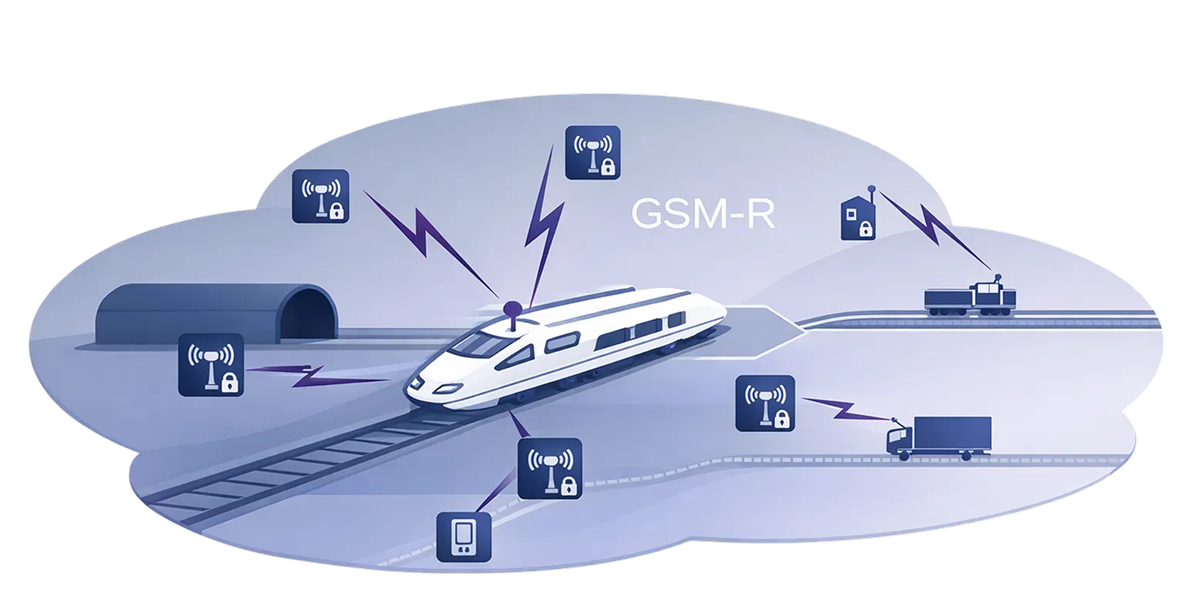
GSM-Railway:
One integrated and standardizes solution
Railway operations were engineered to be fail-safe—but not necessarily secure-by-design.
“The Great Train Cyber Robbery” made that painfully clear: researchers showed how a foothold gained through everyday weaknesses (like credentials baked into firmware) can escalate into system ownership, and from there into the wider railway network—where availability, safety margins, and trust assumptions collide. Kaspersky
This isn’t theory:
are a real attack primitive
A recurring pattern across rail and OT is shockingly simple: devices ship with default or hardcoded logins and they remain unchanged in production. The SCADA StrangeLove team even published SCADAPASS—a dataset of default/hardcoded credentials across industrial devices—explicitly to pressure vendors to stop embedding credentials and to push operators to rotate them. The Register+2GitHub+2
In rail environments, that weakness becomes dangerous because once an attacker controls one edge device, they can often pivot into:
engineering workstations
wayside / depot networks
onboard-to-ground interfaces
and the operational comms layer (including GSM-R connected assets)
GSM-R + modems:
when “communications” becomes the compromise path
GSM-R (railway communications based on GSM) is widely used as a mission-critical channel for railway operations. railroads.dot.gov The “Great Train” research and follow-on analysis highlighted how GSM-R compatible modems and related components can become an entry point—especially where devices support over-the-air firmware updates or inherit known “mobile modem” attack classes that can lead to compromise of the host they’re attached to.
SecurityWeek+2ICT+2
And it’s not just “a modem problem.” It’s an architecture problem:
Remote exploitation chains typically start with:
Segmentation gets blurry between “telecoms,” “IT,” and “signaling.”
And Internet-facing systems get hammered constantly (rail honeypot projects have documented massive volumes of automated password attacks). Rail Engineer
And Internet-facing systems get hammered constantly (rail honeypot projects have documented massive volumes of automated password attacks). Rail Engineer
Open infrastructure is the multiplier
Rail operators (and suppliers) are also building “connected rail” ecosystems—IoT-style device fleets, vendor support channels, remote monitoring. That makes hygiene items like no default credentials and firmware integrity non-negotiable, because one exposed device can become a doorway into the rest. www1.deutschebahn.com
How our AI Cyber Reasoning Engine platform prevents the “Great Train” pattern
Firmware-first discovery: we don’t stop at “source code”
We ingest and analyze:
modem + gateway firmware images
embedded services and web interfaces
configs, update packages, and boot/init logic
rail application code where available
Specialized scanners for rail stacks (GSM-R + embedded binaries)
Our scanners are built for the reality of railway devices:
- Binary-aware scanning for legacy x86/Pentium-class components and embedded modules (control-flow + data-flow analysis, secret hunting, unsafe auth flows).
- Firmware-aware scanning that understands common patterns in modem and edge firmware (credential stores, debug interfaces, update routines, remote management services).
Detect the “firmware passwords” problem automatically
We flag and trace:
hardcoded/default credentials (and where they are validated)
embedded keys/secrets and unsafe storage
insecure update/rollback logic
weak management services and risky exposed ports
pivot paths from comms devices → host → OT network
Remediate, not just report
For high-confidence findings, the platform generates safe fixes (e.g., removing embedded credentials, enforcing rotation, hardening update verification, disabling dangerous services), produces a patch/PR, then re-scans to prove the weakness is gone—so you don’t ship the same trapdoor in the next firmware build.
If you want, tell me what you’re shipping (rail modem firmware, edge gateway, onboard controller software, wayside device services) and I’ll tailor this into a tight landing-page section with your exact artifacts, industries, and outcomes (uptime, safety posture, compliance).